Text-to-SQL
Translate natural-language questions into precise, secure SQL queries validated against your semantic dictionary and data context.
Questions about data, usable answers: analyses, charts, and ready-to-use reports, with controls and traceability in key steps.
Translate natural-language questions into precise, secure SQL queries validated against your semantic dictionary and data context.
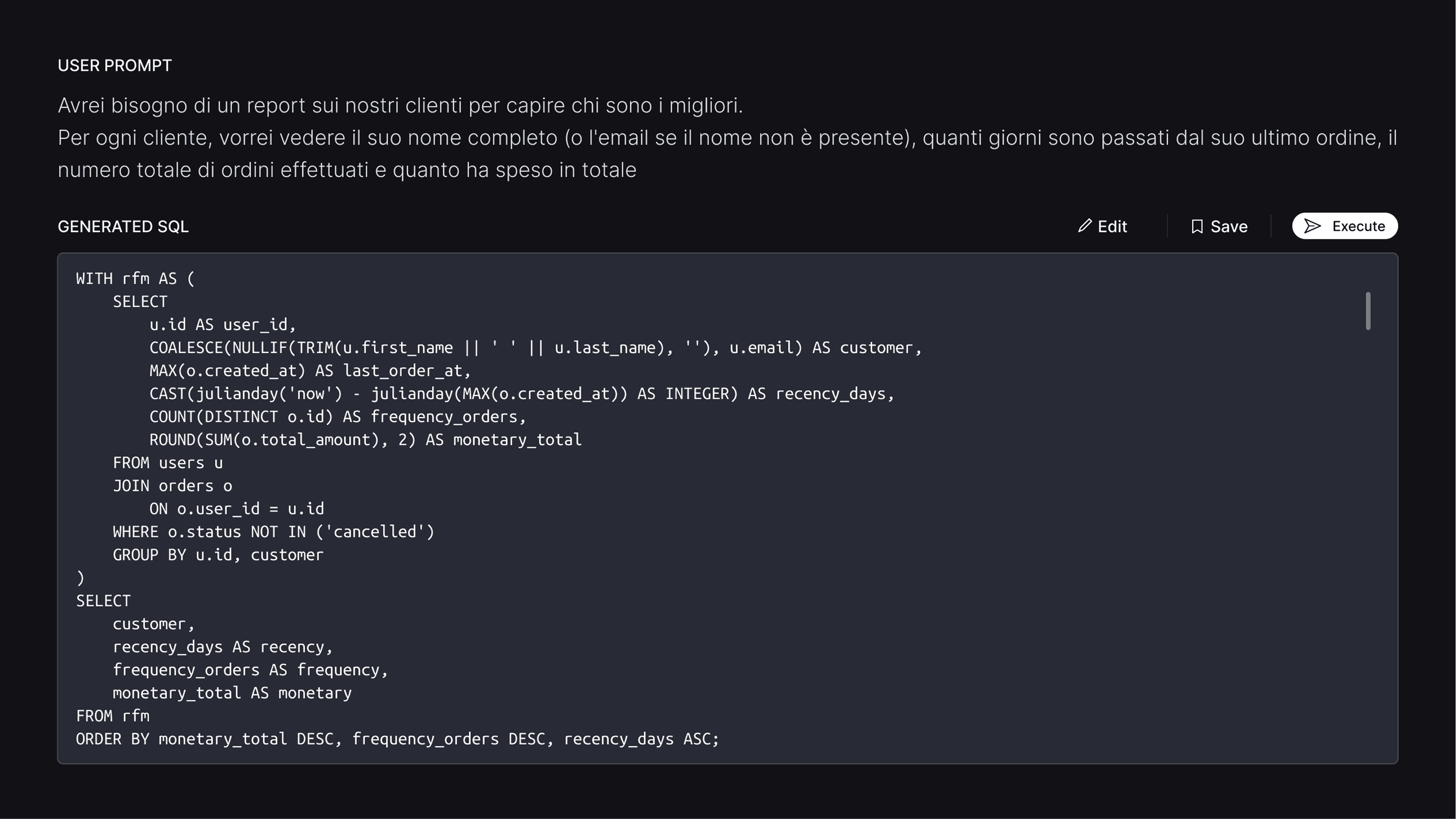
Create dynamic dashboards and charts, then produce exportable reports and summaries ready for day-to-day workflows.

It works with coordinated agents to map data context and run analysis, reducing dependency on deep technical know-how and making data access more direct.

Security layer
Dual includes governance controls from day one: transparent operations, access policies, and review trails built directly into workflows.

Natural-language questions become reliable queries, even on complex databases.

New questions get answers immediately, without rewriting queries from scratch.

Less time on joins and filters, more time on result interpretation.
Visualizations are generated when needed, not only those predefined.
Advanced analysis becomes accessible without increasing technical complexity.

| Feature | Dual Factory | Traditional solutions |
|---|---|---|
Natural-language data access | Enables users to query structured data through natural language, without writing queries or knowing database structures. | Data access requires technical skills or continuous support from specialized teams. |
Controlled and reliable analyses | Generates validated queries aligned with data context, reducing errors, ambiguities, and unreliable results. | Analyses depend on the quality of manually written queries or rigid preconfigured models. |
Verifiability and transparency of analyses | Every analysis is traceable and verifiable: it is always possible to trace back questions, generated queries, transformations, and results. | Reconstructing how an analysis was produced is complex or impossible, especially over time. |
Continuous monitoring and automatic alerts | Enables monitoring of metrics over time and automatic alerts when relevant conditions or thresholds are met. | Monitoring requires manual setup or continuous intervention by technical teams. |
Data governance and security | Respects existing roles, permissions, and policies, ensuring controlled data access and protection of performance and costs. | Direct data access exposes organizations to security, performance, and uncontrolled usage risks. |
Scalability of analysis | Scales across multiple data sources, users, and use cases while maintaining control, consistency, and operational sustainability. | Increasing users, data, or requests creates bottlenecks and dependence on a few specialists. |

Book a live demo and explore how Factory fits your editorial process.