14/07/2026AI Adoption Assessment: Measuring GenAI in the Enterprise
“We’ve bought the subscription to the GenAI software - now we need to get the people who are supposed to use it every day to actually use it,” to paraphrase a well-known saying.
A fair diagnosis, typically followed by: how? With what strategy?
But before tackling those perfectly reasonable questions, there is one that must come first: how do we understand where our organization is starting from, so we can plan a GenAI Adoption strategy that is both calibrated and forward-looking?
It is not a trivial question.
GenAI is the technology that people have adopted faster than any other in human history. Faster than Netflix. Faster than TikTok.
Yet having access to a tool does not mean knowing it, knowing how to use it, or - let alone - having integrated it into your workflows.
Understanding whether an organization is ready for GenAI is not just a matter of infrastructure. Nor is it just a matter of usage. And it is not just a matter of theoretical knowledge.
It is the combination of all these factors, plus one that is often underestimated: each individual’s attitude toward the tool.
Moreover, with GenAI, we are not talking about learning new software. We are talking about a cognitive reconfiguration of the way we approach work.
It is precisely because we believe understanding this complexity is the necessary starting point for a well-designed adoption journey that we developed our AI Adoption Assessment.
Table of Contents
- Measuring the impact and adoption of information technologies
- The three dimensions: Literacy, Fluency, Mindset
- Multidimensional profiles
- Conclusion
- References
1. Measuring the Impact and Adoption of Information Technologies
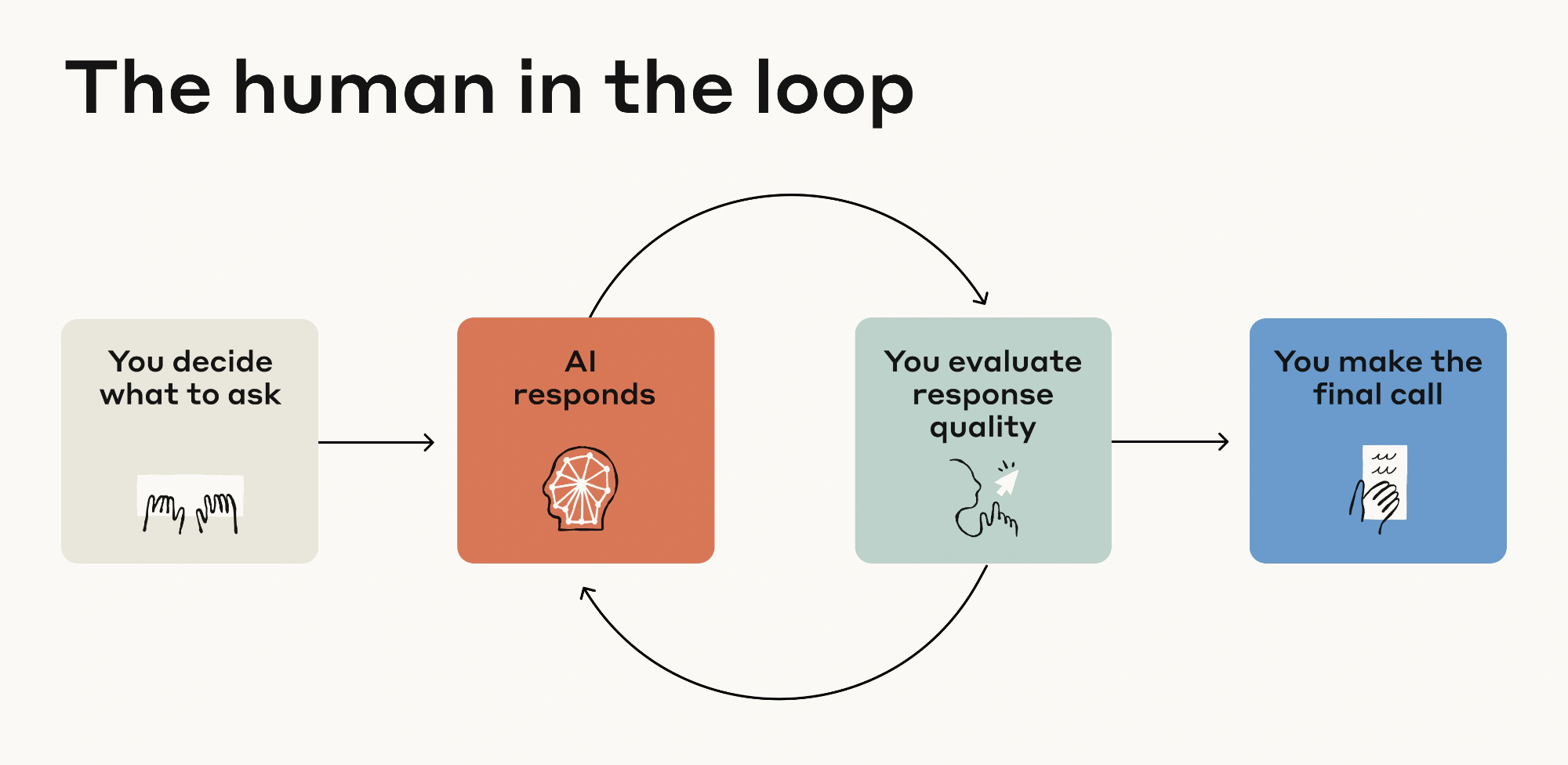
To build our assessment, we started from the scientific literature, which tells us that measuring technology adoption first requires defining what to observe, how to break that observation down into its fundamental components, and what value each component brings.
In psychology and the social sciences, this is done through constructs: variables such as perceived usefulness, trust in the tool, and openness to change. You cannot observe them directly, but you can design questions that measure them indirectly. A construct is what you want to capture, and the questionnaire item is the instrument for capturing it - with the understanding that these constructs, and consequently the questions designed to probe them, are neither chosen nor grouped at random.
The analysis is organized into dimensions: macro-areas of the phenomenon being measured. In the case of GenAI, for instance, it makes sense to measure how much a person knows about it or what attitude they hold toward it.
Each dimension is then broken down into more specific sub-dimensions, yielding a detailed map (called a Blueprint) that specifies which dimensions to measure, how they relate to one another, and how they decompose.
Let us take a step back and contextualize the origins of this blueprint.
Over time, several archetype blueprints have been developed. Among the earliest is the Technology Acceptance Model (TAM) (1989), created to understand what led employees to accept or reject new enterprise software - focusing not on the “how much” but on the “why” (and especially the “why not”) around usage.
In subsequent years, TAM was extended by integrating new variables, eventually giving rise to the UTAUT (Unified Theory of Acceptance and Use of Technology).
In general, these models share several common variables that measure the above primarily through:
- Perceived Ease of Use (PEOU): the degree to which interaction is perceived as intuitive and effortless.
- Perceived Usefulness (PU): the extent to which users believe the technology will improve their productivity. It is the strongest predictor of intent to use, with a statistical weight greater than all other variables. In practical terms: if the added value is clear, people will accept even technical complexity.
- Behavioral Intention and Actual Use Behavior: the output variables - respectively, the willingness to adopt and actual usage.
Alongside these constructs sits Self-Efficacy: the perception of being capable of interacting effectively with a technological tool. It is not a native variable in UTAUT, but it is a transversal construct that was later integrated into these models because it captures something the other variables miss: the bridge between “I use the tool” and “I feel confident in what I’m doing when I interact with it.”
This conceptual framework is indispensable for understanding which variables make sense to measure when we want to obtain a clear quantitative picture of the state of technology adoption.
However, it is a general framework, originally designed for information technologies and theoretically applicable to any digital tool - with appropriate adaptations. GenAI is no exception.
To build an assessment that, starting from these constructs, is capable of measuring the current state and level of GenAI use within an organization, the standard TAM and UTAUT frameworks must be further extended with dimensions that capture the specific characteristics of this new technology.
At Datapizza, we identified three key dimensions frequently referenced in the AI Adoption literature: literacy, fluency, and mindset.
2. The Three Dimensions: Literacy, Fluency, Mindset
Generative AI is frequently compared to the personal computer and the internet - both for its cross-cutting impact on professions and for the speed at which people have started tinkering with it.
This is also why cognitive, emotional, and ethical variables - which had a more marginal impact with earlier technologies - have now taken on central importance.
In particular, recent literature identifies constructs measuring the Mindset dimension as dominant:
- Growth Mindset vs. De-skilling Mindset. Those who perceive AI as a capability multiplier adopt it; those who fear it will atrophy their skills avoid it. A Growth Mindset is a primary predictor of perceived usefulness - the dominant factor in adoption.
- Technical Trust: without a calibrated confidence in the tool and an awareness of its limitations, a constructive mindset either fails to emerge or transforms into blind enthusiasm.
Mindset variables tell us a great deal about who is predisposed to adopt GenAI. But alongside these, other studies highlight a further complementary dimension: GenAI Literacy.
GenAI Literacy refers to an understanding of the fundamental operating principles behind generative AI systems.
It is the glue that binds perceived usefulness to intent to use: without a basic understanding of what lies under the hood, even those with the right mindset risk encountering cascading errors they discover far too late. Several studies identify it as the central mediator of intent to use, and frameworks such as the FAIGMOE (Framework for the Adoption and Integration of Generative AI in Midsize Organizations and Enterprises) identify it as a primary factor for strategically managing cultural change in organizations.
Literacy, self-efficacy, and mindset together tell an important part of the story - cultivating the right attitude toward the tool, knowing its basic operating principles, feeling in control during interaction rather than at the tool’s mercy. But they do not map out the specific skills needed to work effectively with AI.
Knowing what you need to know when delegating a task, evaluating an output, or communicating a complex requirement is genuinely difficult - and demands even more specific competencies.
Using AI is not just about writing a prompt.
As Ethan Mollick, professor at the Wharton School and one of the most influential voices on AI’s impact on work, writes, interacting with AI is more like managing a very fast, very productive junior colleague: you need to know what to ask of them, how to review their work, and when not to trust the result.
Mapping these skills requires a framework dedicated to the specific ways we interact with GenAI tools.
The most comprehensive and specific framework in this space is the 4D AI Fluency Framework, developed by professors Rick Dakan and Joseph Feller in collaboration with Anthropic. It maps human–GenAI interaction through four fundamental categories:
- Delegation: deciding if, when, and how to delegate a task to AI in a strategic way.
- Description: communicating your vision and requirements to AI clearly, going beyond the basic prompt.
- Discernment: critically evaluating the quality and usefulness of outputs, separating what is valuable from what should be discarded.
- Diligence: using AI ethically, responsibly, and transparently, taking ownership of the final output.
The four D’s are the competencies measured in the Fluency section of our assessment.
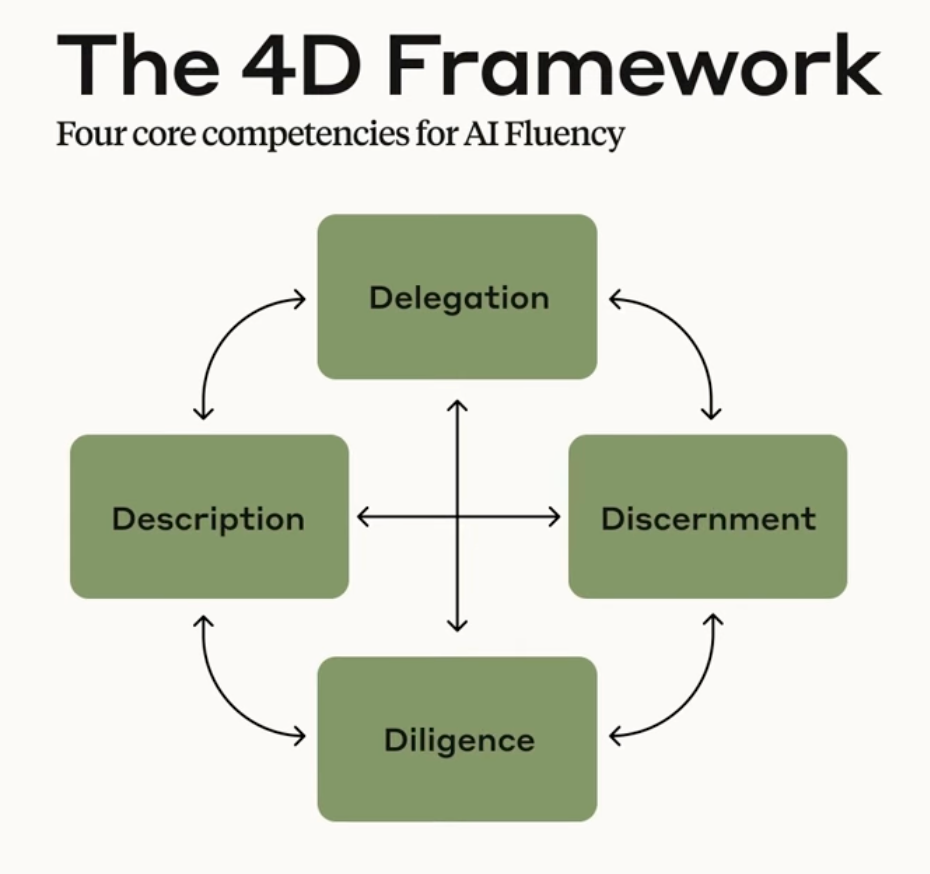
The questions in this section cross the operational competencies of the 4Ds with real-world usage patterns: who uses what, and for which activities, in relation to their professional role - allowing us to read fluency not in the abstract, but within each person’s actual professional context.
Our assessment questions bring all the puzzle pieces together: the mindset and literacy dimensions from psychological frameworks, combined with the GenAI-specific operational competencies mapped by the 4Ds.
The result is a three-dimensional visualization encompassing Literacy, Mindset, and Fluency, mapping each individual along these three coordinates.
This allows us to understand not only whether people in your organization use AI, but how they use it, with what level of maturity and awareness, and what attitude they hold toward the technology.
This is how we map the skills needed to build each participant’s individual profile.
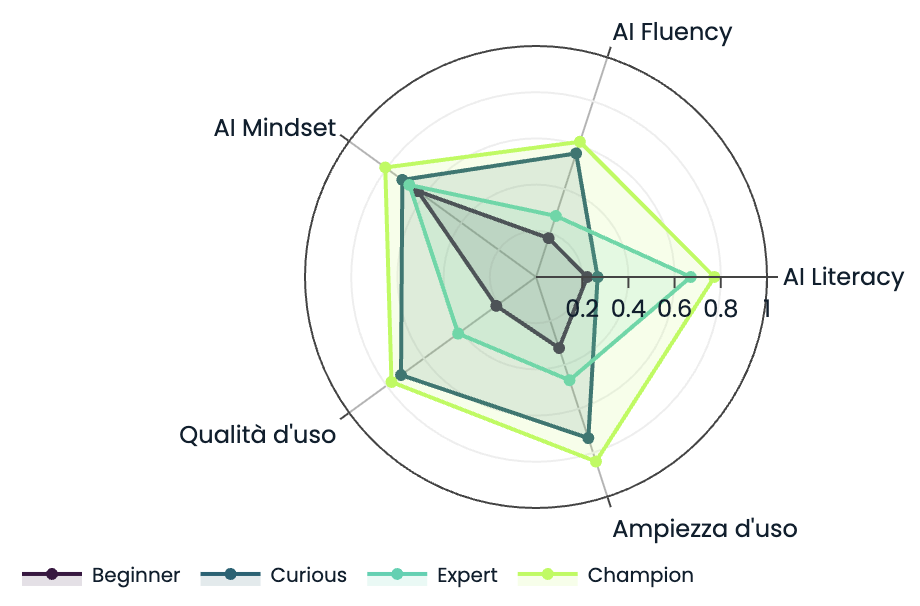
The radar plot allows us not only to compare scores across the three dimensions (literacy, fluency, and mindset) for different profiles, but also to visualize key sub-dimensions of fluency, such as the quality and breadth of GenAI usage.
3. Multidimensional Profiles
Scores are first calculated and presented separately for each of the three dimensions and for each individual.
Aggregating scores across dimensions adds value by segmenting the organizational population into groups - beginner, curious, expert, champion - based on their combined fluency and literacy score.
- Beginner: low fluency, low literacy. Does not use GenAI in a systematic way and lacks the foundation to understand its logic and limitations. This profile requires a carefully designed entry point: without a structured first exposure, there is a risk of forming incorrect beliefs after the first visible error from the tool.
- Curious: high fluency, low literacy. This is the most common profile in companies where AI has arrived bottom-up. They have already integrated GenAI into several tasks, but lack the conceptual tools to understand why one output is reliable and another is not. This is the profile that needs guidance to take the next step and reach a more robust use of the tool.
- Expert: low fluency, high literacy. Knows the theory, follows the debate, understands hallucinations, context windows, RAG. But in their day-to-day work, they have not yet translated knowledge into practice. This is often a senior profile, carrying a bias of “I understand what it’s for and I don’t need it right now,” which ends up blocking the path of exploration.
- Champion: high fluency, high literacy. Uses, understands, delegates strategically, and critically evaluates outputs. The ideal candidate to act as a reference point and guide within your organization for spreading innovation.
The mindset dimension is not used for group segmentation, but is shown as an additional lens on the data - to assess the attitude of different profiles (whether beginners or champions) toward GenAI.
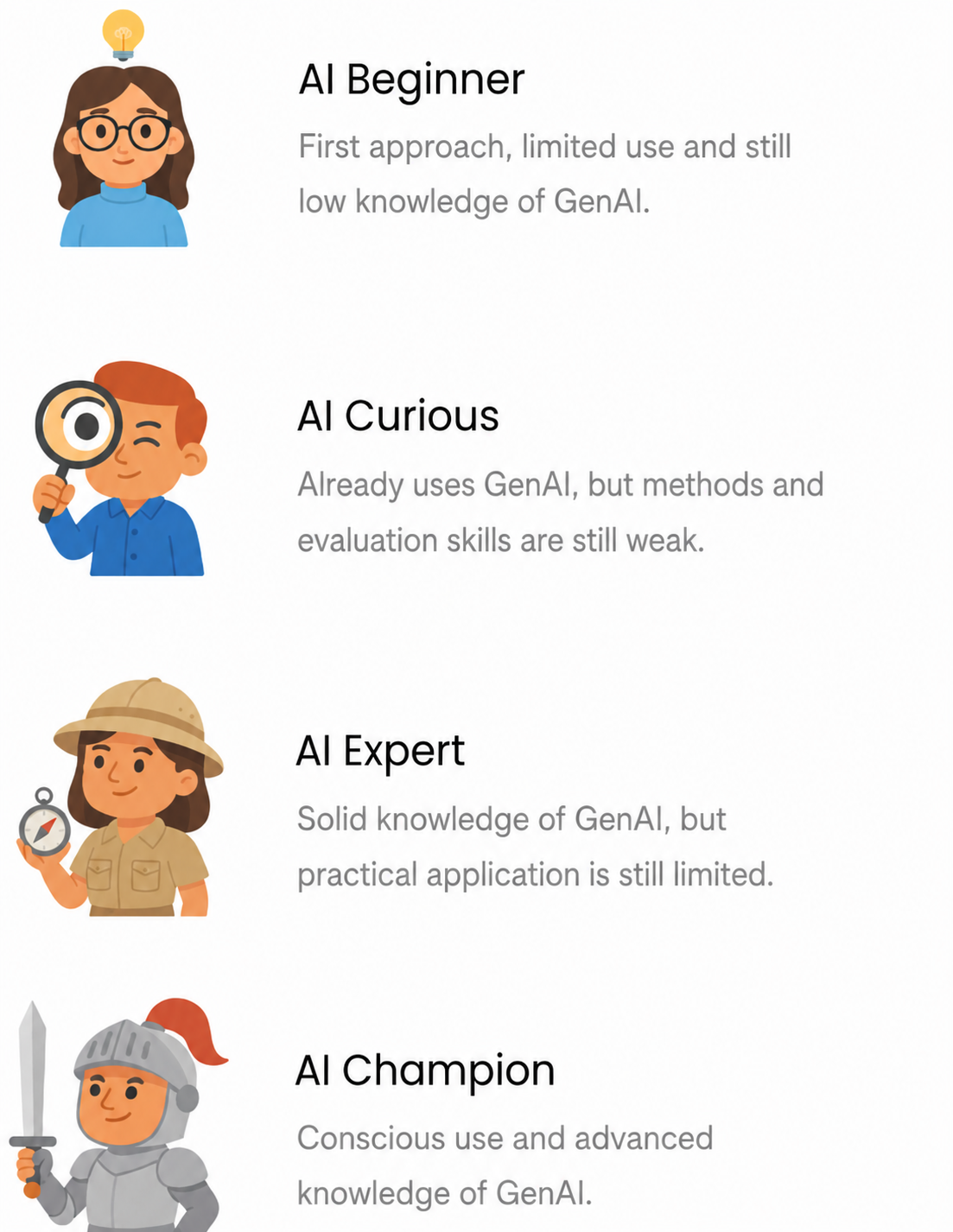
Mapping the organizational population in this way is not a diagnostic exercise done for its own sake. It is what allows you to avoid the most costly mistake of this phase: applying the same adoption strategy to profoundly different populations.
A company with 60% Curious and 5% Champions has a widespread literacy problem: people are using the tool but risk accepting incorrect outputs as valid, and there is not enough internal awareness to correct course. The lever is not “make people use AI more” - it is training on the fundamentals and guidance toward more structured use.
A company with 40% Beginners and 30% Explorers has different needs: on one hand there is knowledge but no engagement, on the other there is a need to guide people through the discovery of the tool. In this situation, the mindset variable plays a fundamental role: having many Beginners who are enthusiastic about learning calls for very different choices in designing training plans than having many Beginners who are cautious or cold toward the challenge posed by GenAI tools.
4. Conclusion
Returning to the opening paraphrase: buying the software subscription is the easy part. The hard part is truly understanding who you are dealing with, before deciding what to ask of them.
Without a starting map, every adoption journey is a blind bet: it assumes the organizational population is homogeneous, that there is only one problem, and that the solution can be copy-pasted.
The time invested in analyzing the situation to understand the starting point pays off in the form of a conscious, targeted choice in the GenAI adoption journey.
If you’re interested in our approach to AI adoption, discover our journey!
References
Bandura, A. (2006). Guide for constructing self-efficacy scales. In F. Pajares & T. Urdan (Eds.), Self-efficacy beliefs of adolescents (Vol. 5, pp. 307–337). Information Age Publishing. https://www.emerald.com/books/edited-volume/18068/chapter-abstract/101339715/Guide-for-Constructing-Self-Efficacy-Scales
Casal-Otero, L., Catala, A., Mariño, C. J., & Fernández-Morante, C. (2023). AI literacy in higher education: A systematic review. International Journal of Educational Technology in Higher Education. https://www.researchgate.net/publication/395432520_AI_Literacy_in_Higher_Education
Davis, F. D. (1989). Perceived Usefulness, Perceived Ease of Use, and User Acceptance of Information Technology. MIS Quarterly, 13(3), 319–340. https://doi.org/10.2307/249008
Deng, H., & Lin, Y. (2024). The construction and validation of the AI Mindset Scale (AIMS). Current Psychology. https://www.researchgate.net/publication/396366817_The_construction_and_Validation_of_the_AI_mindset_Scale_AIMS
Howell, J. (2024, November 18). ChatGPT user statistics and facts for 2025. Exploding Topics.https://explodingtopics.com/blog/chatgpt-users
Lee, A. T., Ramasamy, R. K., & Subbarao, A. (2025). Understanding Psychosocial Barriers to Healthcare Technology Adoption. Healthcare, 13(3), 250. https://doi.org/10.3390/healthcare13030250
Mollick, E. (2024, May 13). Management as an AI superpower. One Useful Thing. https://www.oneusefulthing.org/p/management-as-ai-superpower
Southworth, J., et al. (2024). AI Fluency Framework. https://aifluencyframework.org/ https://aifluencyframework.org/
Venkatesh, V., Morris, M. G., Davis, G. B., & Davis, F. D. (2003). User acceptance of information technology: Toward a unified view. MIS Quarterly, 27(3), 425–478. https://www.researchgate.net/publication/220259897_User_Acceptance_of_Information_Technology_Toward_a_Unified_View
Yang, S., & Huang, R. (2025). Developing a comprehensive framework for AI literacy: Competencies and assessment. arXiv. https://arxiv.org/html/2510.19997v1
Weinberg, A. I. (2025). A framework for the adoption and integration of generative AI in midsize organizations and enterprises (FAIGMOE) [Preprint]. arXiv. https://arxiv.org/abs/2510.19997